
Chapter 6: Operation Gladio: How NATO Conducted a Secret War Against European Citizens and Their Democratically Elected Governments (I von IV)
[This is a chapter from my newly released book ‘The Empire on Which the Black Sun Never Set: the Birth of International Fascism and Anglo-American Foreign Policy.’ For further details on different formats and how to purchase click here.] The audio version of this chapter is available here.
“You had to attack civilians, the people, women, children, innocent people, unknown people far removed from any political game. The reason was quite simple. They were supposed to force these people, the Italian public, to turn to the State to ask for greater security. This is the political logic that lies behind all the massacres and the bombings which remain unpunished, because the State cannot convict itself or declare itself responsible for what happened.”[1]
- Vincenzo Vinciguerra, convicted Italian terrorist, former member of the Avanguardia Nazionale (National Vanguard) and Ordine Nuovo (New Order), part of Italy’s Gladio.
Nazi Germany: The Bulwark of the West against Communism
“By destroying communism in his [Hitler’s] country, he had barred its road to Western Europe…Germany therefore could rightly be regarded as a bulwark of the West against communism.”[2]
– The Earl of Halifax, aka Lord Halifax (British Ambassador to the U.S. 1940-1946, Secretary of State for British Foreign Affairs 1938-1940, Viceroy and Governor-General of India 1926-1931)
Everyone is aware of the Iron Curtain speech delivered by Winston Churchill on March 5th, 1946. However, as already discussed in Chapter 4 it is not Churchill who is the originator of the phrase, but rather Nazi German Foreign Minister Count Lutz Schwerin von Krosigk, who made a speech in Berlin on May 3rd, 1945, which was reported in the London Times on May 8th, 1945.[3] In his speech, Krosigk uses the Nazi-coined propaganda phrase ‘Iron Curtain,’ which was used in precisely the same context by Churchill less than one year later. This sharing of policy between Nazi Germany and England should not come as a surprise at this point, having reviewed the history of British Fascism in Chapter 1 and Churchill’s support for the cause.
The Molotov-Ribbentrop Pact signed August 23rd, 1939, is what has gone down in history in notoriety. However, an important fact is often left out which completely changes the character of the popular interpretation of the Soviet compromise with Nazism, that this notorious pact was signed a full 11 months after UK Prime Minister Neville Chamberlain signed the appeasement deal with Hitler on September 30th, 1938, known as the Munich Agreement (aka the Munich Betrayal).
Historian Alex Krainer writes:[4]
“The story we were taught in school was that the British government agreed to partition Czechoslovakia only as a desperate measure to avoid a greater European war. This view is based on the idea that Germany was already an overwhelming military power that could easily crush Czechoslovakia’s weak defenses. However, this idea is patently false.
…Created in 1919, Czechoslovakia was the most prosperous, most democratic, most powerful and best administered of the states that emerged from the Habsburg Empire… the idea that the Germans had a military advantage and that Czech’s security was weak were both fabrications of a sustained propaganda campaign, which was orchestrated by the British media and government representatives to mislead the British and European public…
In terms of quality, armaments and fortifications, the Czech army was known to be the best in Europe and was superior to the German army in every way except for air support. On September 3rd, 1938, the British military attaché in Prague wrote a cable to London, stating: ‘There are no shortcomings in the Czech army, as far as I have been able to observe…’
In addition, Czech security was supported by strategic alliances with France and the Soviet Union both of whom were at that time very keen on holding Germany in check and both of whom were significantly superior to Germany in terms of military strength.”
That is, Czechoslovakia did in fact capitulate without resistance, but this was not because her defenses were weak. Rather, it was because her government had been given false promises and was ultimately played in favour of Germany by the treacherous scheming of Britain’s secret diplomacy. Lord Halifax, who was quoted earlier, was among the leading British negotiators of the Munich Agreement.
In 1936, Stalin had predicted how German aggression would break out upon the world:
“History shows that when any state intends to make war against another state…it begins to seek frontiers across which it can reach the frontiers of the state it wants to attack…I do not know precisely what frontiers Germany may adapt to her aims, but I think she will find people willing to ‘lend’ her a frontier.”[5]
These statements were made before the Munich Agreement, which was just that, a “lending of a frontier.” In addition, there were multiple attempts by the Soviets to call for a defense pact with France and Britain, in the case that Germany would launch an attack on either side. On March 18th, 1939, at Stalin’s direction Litvinov, Soviet Commissar for Foreign Affairs, proposed that France, Britain, Poland, Russia, Romania and Turkey join together at a conference to draw up a treaty to stop Hitler. Chamberlain was strongly against the idea, writing to a friend: “I must confess to the most profound distrust of Russia. I have no belief whatever in her ability to maintain an effective offensive, even if she wanted to. And I distrust her motives.”[6]
On April 14th, 1939, Lord Halifax, British Foreign Minister said that Britain would not extend an alliance to Russia in case Germany were to attack. Russia was clearly being told to go at it alone.
On April 16th, 1939, Stalin had Litvinov propose to Sir William Seeds the British ambassador, that Russia, France and Britain make a pact that would bind their three countries to declare war on Germany if they or any nation between the Baltic and the Mediterranean were attacked. Great Britain and France again refused.
The Munich Agreement allowed Hitler’s Germany to acquire Czechoslovakia’s superior army and transformed Germany into a colossal military threat that would be much more difficult to defeat. Germany had been allowed to become an ultra-supreme force through direct British intervention. It was only 11 months later that the Molotov-Ribbentrop Pact was signed by the Russians as a means to forestall what was clearly the inevitable; a German attack on Russian soil, with the backing of Britain and France.[7] In addition, the Bank of England (BoE) and the Bank of International Settlements, through BoE Governor Montague Norman, allowed for the direct transfer of 5.6 million pounds[8] worth of gold to Hitler that was owned by the Bank of Czechoslovakia.
Questionable actions from England indeed.
Operation Gladio: NATO’s Dagger
With the Second World War ‘won’, the world was very much under the impression that we were to take the phrase ‘Never Again’ to heart. Unfortunately, those in charge of forming Western policy and geopolitical strategy post-WWII could not have disagreed more.
Operation Unthinkable is a prime example of the sort of thinking that was ruminating within Britain and the United States post-Roosevelt. Operation Unthinkable was the name given to two related possible future war plans by the British Chiefs of Staff against the Soviet Union in 1945. The creation of the plans was ordered by British Prime Minister Winston Churchill in May 1945 and developed by the British Armed Forces' Joint Planning Staff in May 1945 at the end of World War II in Europe (Roosevelt passed away on April 12th, 1945). One plan assumed a surprise attack on the Soviet forces stationed in Germany to “impose the will of the Western Allies” on the Soviets. The second plan was a defensive scenario in which the British were to defend against a Soviet drive towards the North Sea and the Atlantic following the withdrawal of the American forces from the Continent.
Though the first plan of the operation would be shelved with the new government under Clement Attlee, this remained a predominantly governing mindset for British and American intelligence. However, contrary to what we are told today, the second plan of Operation Unthinkable was not shelved. It was in fact fully implemented under the initiation of Prime Minister Winston Churchill. This plan would continue through every other British Prime Minister’s term that followed afterward, without the knowledge of most members of the British government.
During the Second World War, preparations were made in the case of a possible German victory and ‘stay-behind’ guerilla warfare units were stationed throughout Europe. The model was the British Special Operations Executive, or SOE, a top-secret guerilla-commando force established in 1940. It was the brainchild of Winston Churchill and was called ‘Churchill’s secret army.’ This program would eventually be adopted into NATO. After the Allied victory, these ‘stay-behind’ units were not disbanded but rather were strengthened and expanded in almost every European country, with direct aid and encouragement from the United States.
Daniele Ganser, a Senior Researcher at the Center for Security Studies at the Federal Institute of Technology (ETH) in Zurich, Switzerland published NATO’s Secret Armies: Operation Gladio and Terrorism in Western Europe in 2005, which is regarded as an authoritative overview of NATO’s Operation Gladio networks and functions. This chapter will reference extensively Ganser’s pioneering work on this crucial history of Western clandestine warfare that was waged on Western civilians and their democratically elected governments for several decades under the guise of Soviet terrorism.
Daniele Ganser writes in NATO’s Secret Armies:[9]
“The clandestine network, which after the revelations of the Italian Prime Minister [Andreotti] was researched by judges, parliamentarians, academics and investigative journalists across Europe, is now understood to have been code-named ‘Gladio’ (the sword) in Italy., while in other countries the network operated under different names including ‘Absalon’ in Denmark, ‘ROC’ in Norway, ‘SDRA8’ in Belgium. In each country, leading members of the executive, including Prime Ministers, Presidents, Interior Ministers and Defense Ministers, were involved in the conspiracy, while the ‘Allied Clandestine Committee’ (ACC), sometimes also euphemistically called the ‘Allied Co-ordination Committee’ and ‘Clandestine Planning Committee’ (CPC), less conspicuously at times also called ‘Coordination and Planning Committee’ of NATO’s Supreme Headquarters Allied Powers Europe (SHAPE), coordinated the networks on the international level. The last confirmed secret meeting of ACC with representatives of European secret services took place on October 24, 1990 in Brussels.
…Leading officers of the secret network trained together with the U.S. Green Berets Special Forces in the United States of America and the British SAS Special Forces in England…In case of a Soviet invasion of Western Europe the secret Gladio soldiers under NATO command… [formed a] stay-behind network operating behind enemy lines.”
However, the expected Soviet invasion never occurred. And thus, these secret armies found another purpose. They were to be used against the people. The desire was that by staging false-flag operations that were blamed on communists, panic and revulsion would be invoked sending voters flocking to the welcoming arms to so-called ‘secure’ right-wing governments. Italy, which had the largest and most powerful communist party in Europe, would be first on the hit-list. The Communist Party of Italy, admired for leading the fight against Mussolini, was expected to win in Italy’s first post-war election in June 1946. This, of course, was considered intolerable under the Iron Curtain diktat.
Investigative journalist Christopher Simpson writes in his book Blowback, how a substantial part of the funding for the opposition to the Communist Party of Italy, which was the Christian Democratic Party, came from captured Nazi assets, largely held by the Americans. This intervention tipped the balance in favour of Italy’s Christian Democratic Party, which hid thousands of fascists in its ranks. The Christian Democratic Party would be the dominating party in Italy for five decades until it was dissolved in 1994.
In March 2001, General Giandelio Maletti, former head of Italian counterintelligence, suggested that next to the Gladio secret army, the Italian secret service and a group of Italian right-wing terrorists, the massacres which had discredited the Italian communists had also been supported by the White House in Washington and the CIA. At a trial of right-wing extremists accused of having been involved in the Piazza Fontana massacre, General Maletti testified:
“The CIA, following the directives of its government, wanted to create an Italian nationalism capable of halting what it saw as a slide to the left, and, for this purpose, it may have made use of right-wing terrorism…The impression was that the Americans would do anything to stop Italy from sliding to the left… Italy has been dealt with as a sort of protectorate [of the United States]…”[10]
In order to ensure that no further communist support were to arise in Italy, Operation Gladio, with direction and support from the CIA and MI6, led a campaign of brutal violence against Italians that stretched into the better part of two decades known as the ‘years of lead,’ the anni di piombo.
Daniele Ganser writes in NATO’s Secret Armies:[11]
“According to the findings of the Belgian parliamentary investigation into Gladio, a secret non-orthodox warfare even preceded the foundation of the alliance [NATO]. As of 1948, non-orthodox warfare was coordinated by the so-called ‘Clandestine Committee of the Western Union’ (CCWU).
…When in 1949 the North Atlantic Treaty was signed, CCWU [Clandestine Committee of the Western Union] was secretly integrated into the new international military apparatus and as of 1951 operated under the new label CPC [Clandestine Planning Committee]. At the time European NATO headquarters were in France and also the CPC was located in Paris. Like the CCWU before it the CPC was concerned with the planning, preparation and direction of non-orthodox warfare carried out by the stay-behind armies and Special Forces. Only officers with the highest NATO security clearance were allowed to enter CPC headquarters…under the guidance of CIA and MI6 experts the chiefs of the Western European Secret Services met at regular intervals during the year in order to coordinate measures of non-orthodox warfare in Western Europe.”
In 1959, an internal NATO briefing minute, dated June 1st, 1959, slipped into the hands of a British newspaper, which revealed that the task of the stay-behind units had been switched from confronting a Soviet invasion to confronting an “internal subversion”. The secret armies were henceforth to play a “determining role…not only on the general policy level of [domestic] warfare, but also on the politics of [domestic] emergency.”[12] What this meant was that a secret army of stay-behind units, under the direction of NATO, in absence of a Soviet threat, were to direct their actions to internal matters which would include espionage and acts of terrorism on the citizens of Europe with the support and cover of those nations’ police units. This would be used to further centralise control within right-wing governments who supported the NATO apparatus.
Operation Gladio, which used the tactic Strategy of Tension, functioned on three basic levels. The first was a guerilla war to be fought primarily on the streets, in order to draw loyalties away from the Soviet Union. The second level was the political front and would involve NATO-inspired conspiracies, which typically accused certain governments of being in secret partnership with the USSR, in order to evict democratically elected governments unfriendly to the NATO state apparatus and replace them with puppet regimes. The third level was the assassination (hard and soft) of figures who were deemed obstructive to NATO’s aims. Examples of Gladio assassinations include Italy’s former Prime Minister Aldo Moro in 1978, Sweden’s Prime Minister Olof Palme in 1986 (known as Sweden’s JFK), Turkey’s Prime Minister Adnan Menderes in 1961 along with two cabinet colleagues, and U.S. President Kennedy in 1963. As well as the soft assassination (character assassination) of UK Prime Minister Harold Wilson. These assassinations would typically be followed by a NATO/U.S. supported putsch. Attempted assassinations from Operation Gladio included President de Gaulle (more on this shortly) and Pope John Paul II.[13]
Yves Guerin-Serac: the Black Ops Grandmaster behind Operation Gladio
“He [Yves Guerin-Serac] was in thrall to his personal vision of a Christian-Fascist New World Order. He was also the intellectual mentor of Gladio terrorism. He wrote the basic training and propaganda manuals which can be fairly described as the Gladio order of battle.”
- Richard Cottrell, Gladio: NATO’s Dagger at the Heart to Europe
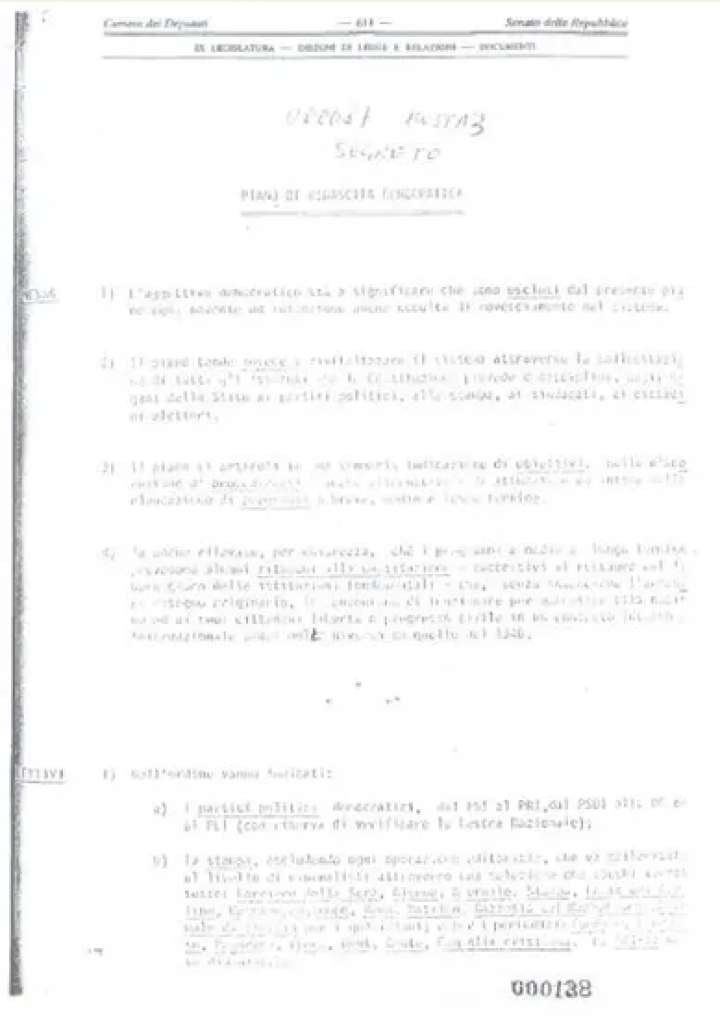
Guerin-Serac was a war hero, agent provocateur, assassin, bomber, intelligence agent, Messianic Catholic, and the intellectual grandmaster behind the ‘Strategy of Tension’ essential to the success of Operation Gladio. Guerin-Serac published via Aginter Press the Gladio manual, including Our Political Activity in what can aptly be described as Gladio’s First Commandment:[14]
“Our belief is that the first phase of political activity ought to be to create the conditions favouring the installation of chaos in all of the regime’s structures…In our view the first move we should make is to destroy the structure of the democratic state under the cover of Communist and pro-Soviet activities…Moreover, we have people who have infiltrated these groups.”
Guerin-Serac continues:[15]
“Two forms of terrorism can provoke such a situation [breakdown of the state]: blind terrorism (committing massacres indiscriminately which cause a large number of victims), and selective terrorism (eliminate chosen persons)…
This destruction of the state must be carried out under the cover of ‘communist activities.’ After that, we must intervene at the heart of the military, the juridical power and the church, in order to influence popular opinion, suggest a solution, and clearly demonstrate the weakness of the present legal apparatus. Popular opinion must be polarized in such a way, that we are being presented as the only instrument capable of saving the nation.”
Anarchic random violence was to be the solution to bring about such a state of instability thus allowing for a completely new system, a global authoritarian order. Yves Guerin-Serac, who was an open fascist, would not be the first to use false-flag tactics that were blamed on communists and used to justify more stringent police and military control from the state.
On the 27th of February 1933, Hermann Göring, Hitler’s second-in-command, shouted outside the burning of the Reichstag:
“This is the beginning of the Communist revolution! We must not wait a minute. We will show no mercy. Every Communist official must be shot, where he is found. Every Communist deputy must this very day be strung up!”[16]
It is quite incredible that people never seem to grow tired of these sort of theatrics as part of the popular narrative of what we are told shapes our history, no matter how many times we have heard it played before. The line of obvious patsies is also something that seems to never grow tiring. In the case of the Reichstag fire, now widely acknowledged as a false-flag, it was some befuddled Dutch Jew that was instantly accused.
The day after the fire, six days before the scheduled general election, Hitler persuaded the elderly and confused President von Hindenburg (the icon of the First World War) that the crisis was of such profound gravity it could only be met by complete abolition of all personal liberties. The Reichstag Fire Law conferred by Hindenburg gave Hitler many of the instruments that he required for a total seizure of power. Within two weeks, parliamentary democracy was also reduced to the smoking embers of history. It would not be the only false-flag to be orchestrated by Hitler.
Richard Cottrell writes in Gladio, NATO’s Dagger at the Heart of Europe :[17]
“SS units forced a small group of concentration camp victims ‘released’ from Buchenwald and disguised in Polish uniforms, to stage a false flag mock attack on the main radio tower in the Nazi controlled free state of Danzig. Citing provocation by the Poles, the German invasion of Poland followed.”
Guerin-Serac spent his life dedicated to a new Black Empire[18] which he dreamed would combine the universal divinity of the Roman church with the United States and Europe as successor to the Holy Roman Empire. This was Christian Fascism and Yves Guerin-Serac was its Crusader.[19] He belonged to several old gangs, including the first generation of ‘former’ Nazis and fascists. He also belonged to a veteran clan of French officers blooded in the Indochinese and Korean struggles and was a member of the elite troop of the 11ème Demi-Brigade Parachutiste du Choc, which worked with the SDECE (French intelligence agency). His connection to French Intelligence would be key in his becoming a founding member of the Organisation Armée Secrète (OAS), a French terrorist group, made up of disaffected French officers, based in Spain which fought against Algerian independence. Guerin-Serac would form an intricate paramilitary and terrorist network throughout Europe, as well as training facilities to service Operation Gladio, via the cover of Aginter Press.
Cottrell writes:[20]
“Guerin-Serac arrived in Lisbon in 1966 with an inspirational blueprint for the next stage of the struggle against godless liberalism. He proposed…an organization that would act as nothing less than an international travel agency for terrorists. The principal funding was supplied by the CIA, according to the Pellegrino Commission established in 1995 by the Italian Senate to investigate the anni di piombo [years of lead]. Guido Salvini was the magistrate appointed to examine the 1969 bombing of the agricultural bank in Milan’s Piazza Fontana. He pinned the blame firmly on Guerin-Serac’s Aginter Press. Salvini told the senators that Aginter operatives were active in Italy from 1967 onwards, instructing local militant neo-fascist organisations in the use of explosives. From this nugget, the CIA is positively connected to the Gladio wave of terrorism sweeping Europe.”
Behind the plain business shopfront of Aginter Press lay an invisible network designed to shuttle terrorists around Europe, Latin America, and Africa providing false documents and passports for killers posing as reporters and photographers including Guerin-Serac.[21]
Cottrell continues:[22]
Info: https://cynthiachung.substack.com/p/operation-gladio-how-nato-conducted?utm_source=substack&utm_medium=email“Aginter… was a Gladio finishing school, where recruits to the secret armies from all over Europe were trained in the arts of bomb making, assassination, psychological operations, destabilisation and counter-insurgency. Much of this was borrowed from the textbooks of the U.S. Army’s centre for covert warfare at Fort Bragg. Guest instructors from time to time included members of Britain’s SAS, the Green Berets …Guerin-Serac was blithely summoned to next door Spain to organise the death squads crushing resistance to the Franco regime. Aginter activities have been traced to all those countries where the Strategy of Tension operated at peak volume: Turkey, Greece, Cyprus, Italy, Germany and Belgium.”

 Quelle: Sputnik © Михаил